

Bioengineering Senior Design
At the University of Pittsburgh, Bioengineering Senior Design is a year long course in which teams research unmet clinical needs and then design a solution around them. (A summary of my contributions throughout the year can be found at the end of this webpage)
My team considered 7 different topics:
-
Continuous Lung Function Data
-
Patient Transport/Mobility in Emergency and Clinical Situations
-
Wheelchair Users Getting Dirty Hands
-
Fall Prevention for Elderly Patients
-
Feminine Hygiene Waste and Accessibility
-
MRI Claustrophobia
-
Ease of Donning and Using Medical Gloves
After completing ethnographic research and analyzing these ideas, we chose to pursue the Ease of Donning and Using Medical Gloves.
Wearing gloves is a vital part of the health profession, especially given the heightened health and safety precautions that have been implemented due to the COVID-19 pandemic. Thus, wearing gloves becomes a vital step in the daily routine of many nurses, doctors, and technicians. However, sanitization and hand washing are equally important steps, but this often leaves hands damp, and makes gloves extremely difficult to put on. Thus, a solution is needed to improve the way health professionals don gloves to make the process easier and quicker, especially with damp hands. The proposed solution to this need is a compressed air system with an attached funnel, that will allow the user to both dry their hands and inflate their gloves to allow for easy and sanitary donning.
Concept Brainstorm
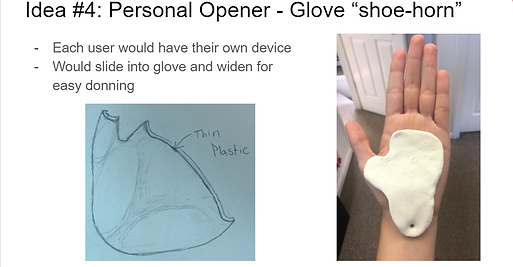
One of our tasks involved brainstorming various design concepts and then conducting "killer experiments" to narrow down these ideas. We prototyped multiple concepts. I created a rough prototype for a sort of "glove horn" that would help to open the glove.
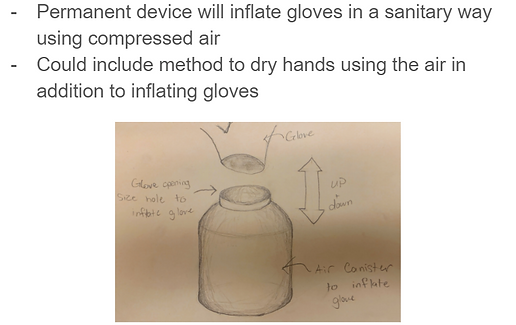
After quickly testing our concept prototypes with students in the Pitt School of Nursing, we decided to go with a sanitary inflation device. I believe this concept is a good choice as many medical professionals stated that they often blow into the glove to make application easier, and this inflation device would provide an effective yet more sanitary option.
Fall 2020 Swanson Engineering
Design Expo
We presented our project at Pitt's virtual Design Expo Fall 2020, and our team won first place in the Bioengineering category out of 12 Bioengineering design teams. I aided in completing this video by creating visual components and recording audio segments.
Documentation

A large portion of Pitt's Bioengineering Senior Design program involves documentation, including documents that satisfy approval requirements from the University's Institutional Review Board, as well as Design History File documents in accordance with regulations from the U.S. Food and Drug Administration. Our team divided up the documentation work, and my specific contributions included:
-
Ethnography Plans
-
Evaluation of "unmet needs"
-
Potential Human Subjects Testing Analysis
-
Use Cases related to customer archetypes
-
Risk Analysis Summary
-
Prototype Material Selection and Rationale
-
Validation Test Plan
-
Storyboarding for video documentation
-
Validation Protocols
-
Validation Test Reports
-
Patentability and Infringement Assessment
-
FDA Pre-Submission
Prototyping
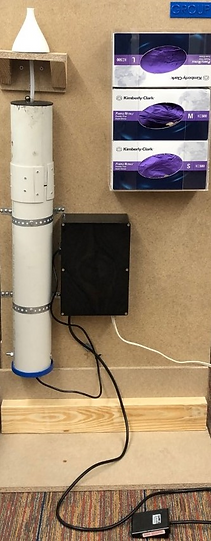
Our current prototype is a compressed air system that will allow the user to both dry their hands and inflate their gloves to allow for easy and sanitary donning. It specifically contains a linear actuator coupled with a syringe and a 3D printed funnel, and is powered by a foot pedal and Arduino electronics
Verification Testing

Goal: Test that design meets specified requirements. I helped to analyze data by creating graphs like the Noise Evaluation plot to the left.
Noise Evaluation
→ Measured via noise dosimeter
Cleaning Evaluation
→ Visual inspection after CDC sanitization procedure
Physical Evaluation
→ Device weighed and dimensions measured
Air Output Evaluation
→ Visual confirmation of inflation
Surface Roughness Evaluation
→ Evaluated via ContourGT-I 3D Optical Microscope or KLA surface profiler
Electrical Safety Evaluation
→ Measurements via multimeter
Validation Testing

Goal: Test that design actually meets user needs. I wrote the protocol and test report for the Time Reduction Evaluation. I also aided in performing all the validation testing, and compiled validation data into spreadsheets and across referenced with testing with nursing students and faculty vs. team members. The image to the left is an excerpt from my data analysis of the time reduction test.
Ease of Glove Donning Evaluation
→ Rated on scale from 1 to 10
Time Reduction Evaluation
→ Recorded via iPhone timer
Rip Reduction Evaluation
→ Visual confirmation
Environmental Factors Evaluation
→ Rated on scale from 1 to 10
Device Safety and Confidence Evaluation
→ Rated on scale from 1 to 10
Spring 2021 Swanson Engineering Design Expo
We presented our project at Pitt's virtual Design Expo Spring 2021. I aided in completing this video by creating visual components, and I created a large portion of the components of the expo poster below.

Summary of my Senior Design Project Contributions
My contributions to my capstone project include but are not limited to the following:
Semester 1
-
Unmet Need Identification research topic: Patient Transport/Mobility in Emergency and Clinical Environments
-
Ethnography plans and reports: documentation for the aforementioned research topic as well as various meeting notes for other topics
-
Potential solution sketching
-
Storyboarding scenes for V&V testing
-
Creation of low-res prototype: glove horn
-
Use case and user needs documentation
-
IHA and Risk Summary documentation
-
Material Selection Rationale
Semester 2
-
Verification and Validation efforts: protocols (Time reduction), data collection (validation), data analysis (validation and verification), test reports (Time reduction)
-
North Eastern Bio Engineering Conference (NEBEC): abstract and video submission, conference presentation
-
Change management SOP simulation
-
Patentability and Infringement assessment
-
Sprint Design Expo Poster
-
FDA Pre-Submission
-
Final Project Documentation